On Roundness and Love. A Jewelry Manifesto
If you had to store all your love in one place, what shape would it be? I suspect something round.


[Part 2]
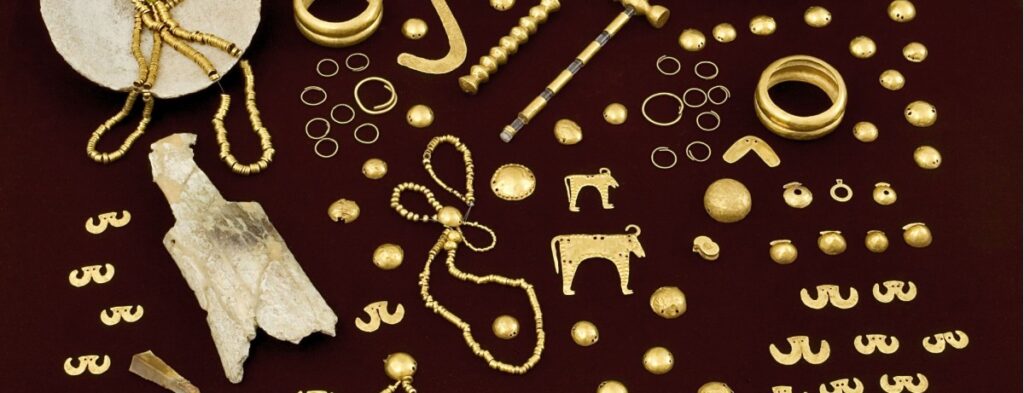
A respected man was buried at a necropolis near the Black Sea coast of Bulgaria around 4600 BC. He had 1.5 kilograms of gold objects on his body — pectorals, bracelets, rings — whose weight exceeded that of all other gold objects on planet earth at that time, combined.
Gold was on the body before it was in the treasury, before it was stamped into coins, before anyone thought to trade it by weight. For most of its history with us, gold was not money, it was intimate — it was worn. Either by the dead or the living.
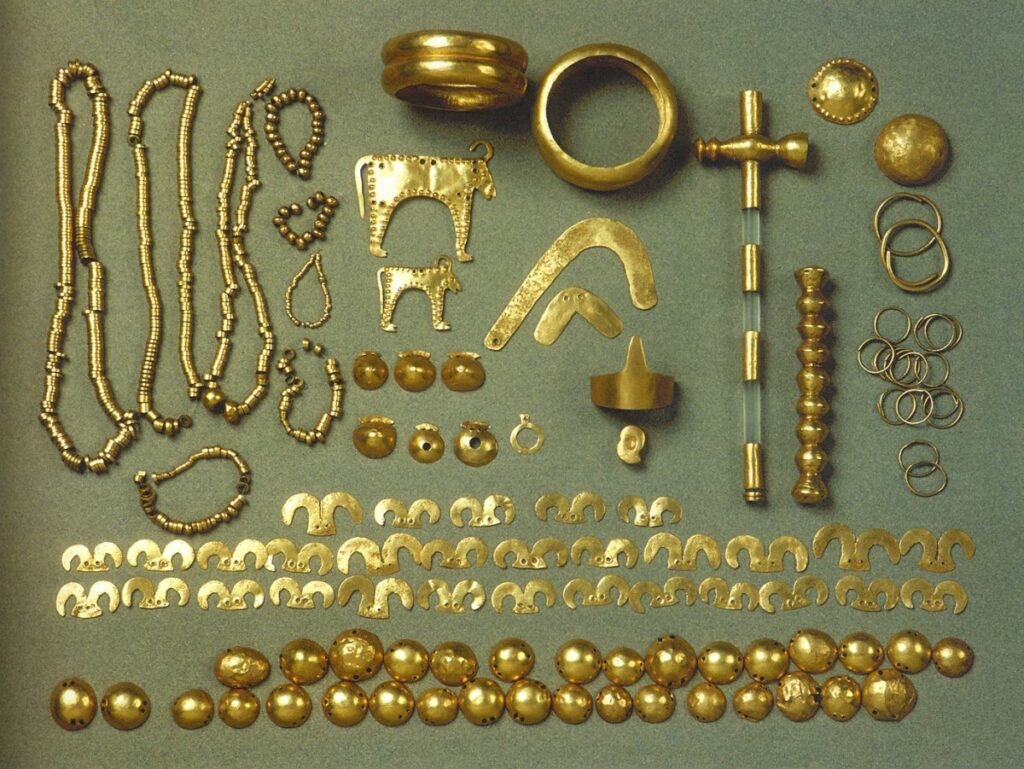
The Varna Chalcolithic Necropolis, Artifacts, Owner: @VISIT.Varna.bg
The first gold coins didn’t appear until around 550 BC in Lydia, in what is now Turkey — a gap of over four thousand years. Gold was jewelry first and currency second.
And for most of the centuries that followed, gold remained both. Economies ran on it. Currencies were defined by it — a dollar was not a metaphor but a fixed weight of gold, a British pound the same. Gold didn’t have a price because gold was the price. Everything else was measured against it.
On a peaceful Sunday in August 1971, the American president Richard Nixon announced that the dollar would no longer be exchangeable for gold. The link that had held for centuries was cut. Gold was released into the open market, and for the first time in modern history its value began to float — rising and falling with every war, every crisis, every tremor of collective fear. In the decades since, gold has become something it never was before: a barometer of social anxiety.
When someone melts a ring today, they are reversing the oldest relationship humans have with this metal. They are converting its first function into its last — and the last function offers no guarantees.
In March 2026, gold lost over twenty percent of its value in less than two weeks. Why? War, oil, interest rates — things that have nothing to do with a wedding band. That woman in Los Angeles who melted her family’s jewelry in January watched the price drop by a fifth. The market moved on. And the molecules of her grandmother’s ring became part of a gold bar, locked in a dark vault somewhere, indistinguishable from its neighbours.
Meanwhile, there is a quiet countermovement happening, too. Some people are redesigning heirlooms rather than destroying them — resetting a grandmother’s stone into a modern band, melting old gold into a new form that someone will actually wear.
The object gets a second life. And unlike the refinery, it remains a piece of jewelry — something that will touch someone’s body again, and begin a new conversation.
That conversation — between skin and metal, between warmth and weight — is recorded in every scratch, every thinning of the band, every patina. It is a conversation that cannot be reproduced, repurchased, or restored.
A gold bar holds value. A gold ring holds something else. The market can tell you the price of one. It has no language for the other.
Words by Daria
If you had to store all your love in one place, what shape would it be? I suspect something round.
[Part 1] A woman walks into a gold shop in downtown Los Angeles carrying a small velvet pouch.
Paintings hang on walls. Sculptures sit on pedestals. Jewelry occupies a quieter, not as prominent spot.