Some Things Should Not Be Weighed in Gold
[Part 2] Gold was worn before it was spent. That distinction still matters.


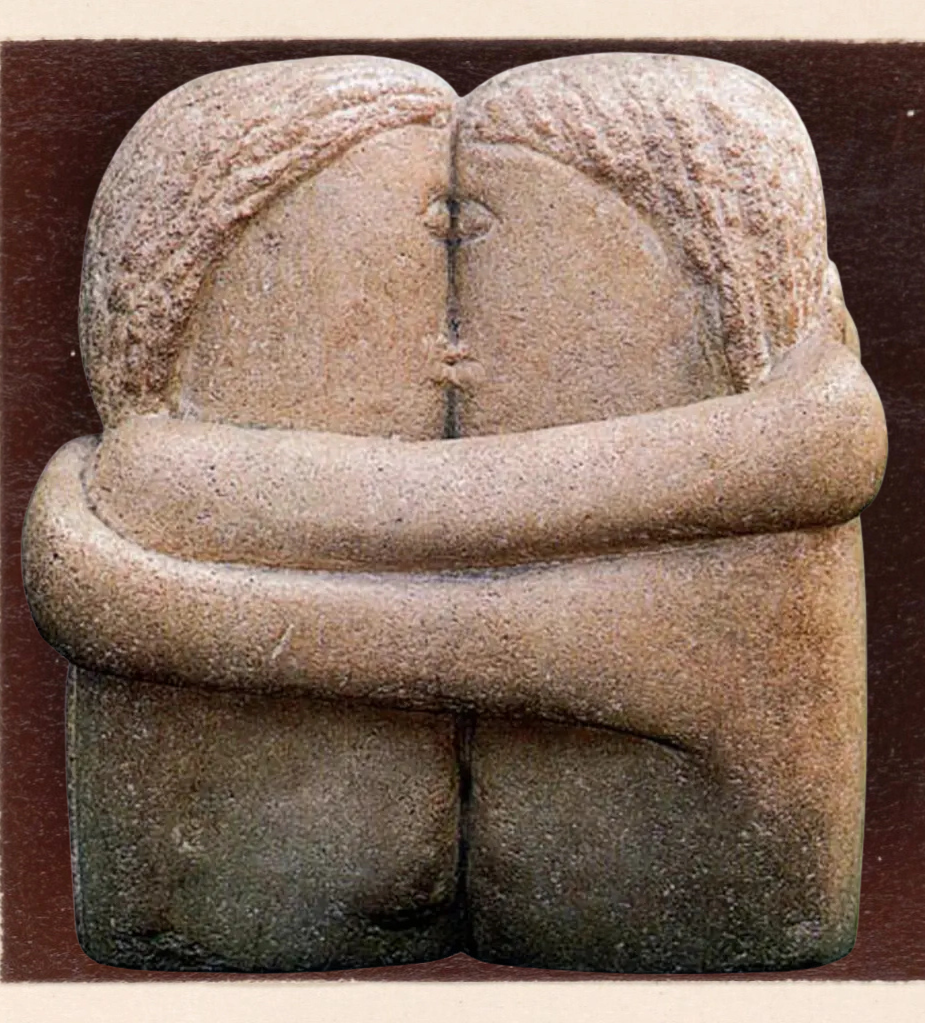
If you had to store all your love in one place, what shape would it be? I suspect something round.
There is a reason that image feels natural – a phenomenon called the curvature effect: people of different cultures and ages tend to perceive curved forms — lines, objects, movements — as more safe, calm, tender, even playful, while angular ones read as threatening, aggressive. Why this is so, no one has settled — it may be older than culture, or made by it. Whatever it is, the appeal of the round seems universal.
If we look around, most things in the natural world are rounded: galaxies, planets, orbits, birds, eggs, cocoons, fruits, stones, cells, raindrops. Angles are rare, and usually the trace of a break, a fracture. That’s the physics of it: things settle into the shape that takes the least effort to hold, and that shape is a curve. To make an angle, there has to be something forcing it — like the lattice a crystal grows along, or a break. A curve needs no special push. It appears on its own — with wind, water, time, slowly wearing everything round, until what’s left is simply the easiest shape to be.


We may be drawn to roundness simply because it is familiar. The world is mostly round and mostly safe (the round world, at least, never cuts anyone) — we like the round, because we like to be safe. But what if round is also the shape of the mind, or even being? Bachelard, in The Poetics of Space, gathers several independent testimonies that being itself is round, and insists they are not mere metaphors. Van Gogh saw life as round — hard to argue. Karl Jaspers wrote that being is round. The oldest version of this intuition is also the most beautiful. The Greek philosopher Empedocles imagined the world as a play of two forces: Love, which draws things together, and Strife, which pulls them apart. When Love fully prevails, everything is gathered into one, and the shape that union takes is a sphere, what he called the Sphairos. For Empedocles, then, roundness is not just a shape among shapes. It is what love looks like when it is complete: nothing left out, no edges, no divisions, a whole. And yet — the Sphairos contains nothing in particular. No edges means no maple leaves, no mountain peaks, no roman-nosed faces. The living world begins only when Strife cracks the sphere. The angle is the price of there being anything to love at all.
Nature, at least, rations its angles. But what about the things we produce? Shelves, walls, books, boxes, doors, screens — they surround us. Since mass production, the angle has been cheap. In experiments, the same face assembled from sharp-edged puzzle pieces is judged more aggressive than one assembled from curves; a room of sharp objects nudges people toward the aggressive choice. Minutes of angles were enough. What a lifetime of them does — nobody knows. Perhaps nothing. Perhaps we constantly carry a faint memory of the crack.
Roundness is not only a shape, it is also a motion. While angular objects stand still — the edge arrests its movement — round things roll, they orbit, and come back. The year goes out into winter and returns as spring. We love it when life comes full circle: a conversation that began at one table finds its way, years later, back to the same table. And it is not a mere repetition — the line went out into the world and refused to stay a line. The moment an ending touches its beginning, the distance between them closes into a shape. Going in circles feels bad only when the circle is too small, but at the scale of a life, it is a completion.
Of all the round things we make, the ring is the smallest and the most binding. A ring is round twice: its own circle, and the space it holds. And if it carries a diamond, the diamond is all angles — the sharpest thing mounted on the gentlest shape. It doesn’t hurt you. When you touch it, you follow the curve and glide. And it does what the first question asked: it holds your Love in the safest shape there is.
Literature
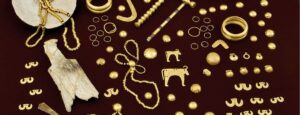
[Part 2] Gold was worn before it was spent. That distinction still matters.
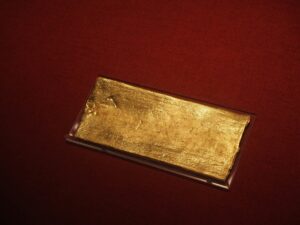
[Part 1] A woman walks into a gold shop in downtown Los Angeles carrying a small velvet pouch.
Paintings hang on walls. Sculptures sit on pedestals. Jewelry occupies a quieter, not as prominent spot.